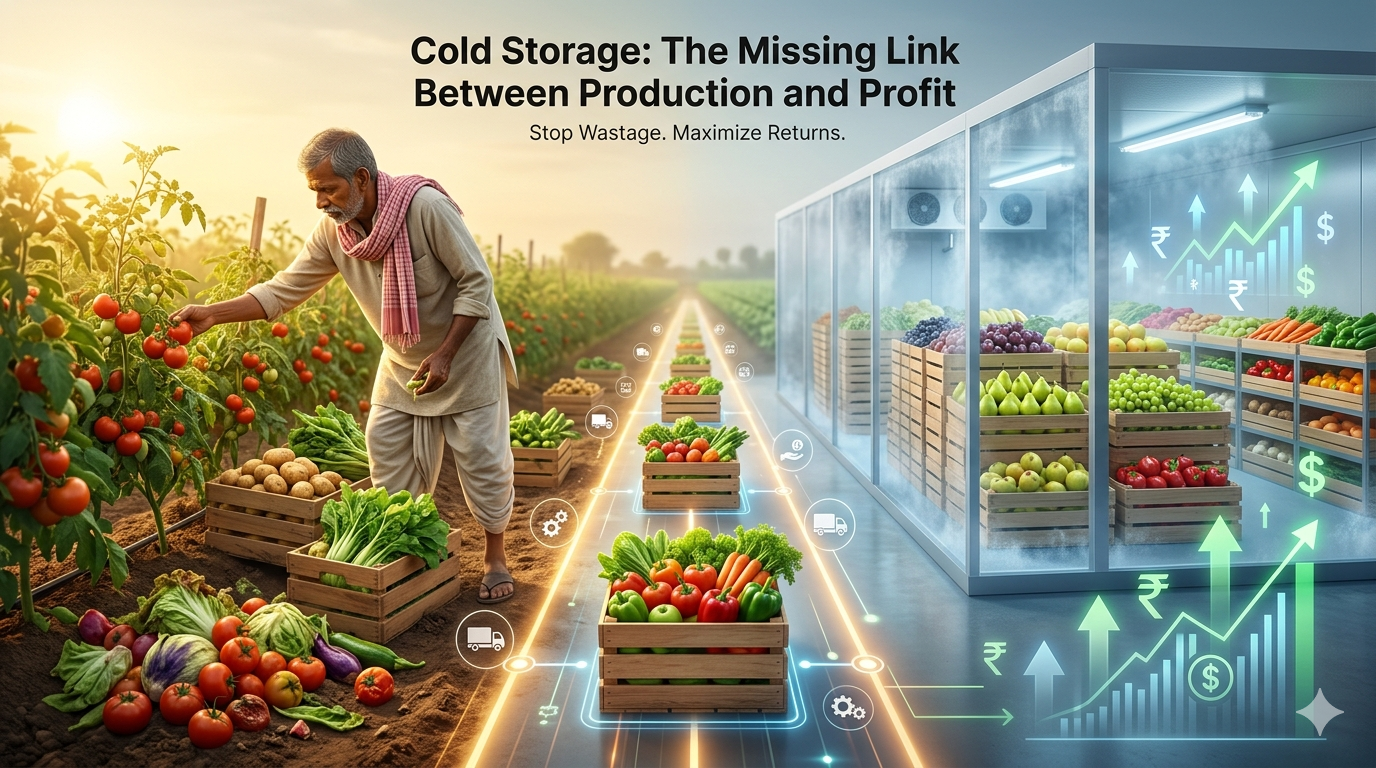



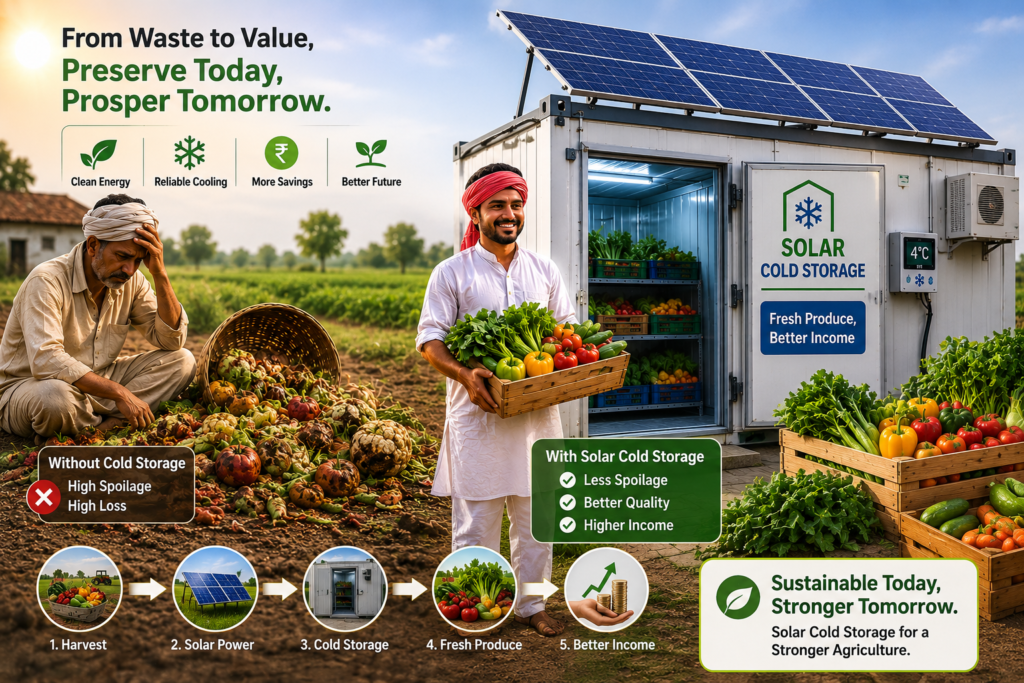
Each year, over 20% of India’s fruits and vegetables spoil after harvest, resulting in a ₹92,651 crore economic loss. This significant waste is primarily caused by the fact that many farmers, particularly in rural areas where electricity is intermittent and diesel generators are prohibitively expensive, lack access to reliable and reasonably priced cold storage facilities. However, by combining precision refrigeration with renewable energy technology, solar cold storage offers a revolutionary method of preserving perishable goods from farm to market.
The Scale of Food Waste in India
India produces over 300 million tonnes of fruits and vegetables annually, yet an estimated 68 million tonnes never reach consumers. Fruits face losses between 20 and 25%, amounting to 28,000 crore rupees. Vegetables suffer even higher losses at 25-30%, representing 45,000 crore rupees. Dairy products lose 15-20% annually, valued at 12,000 crore rupees, while root crops lose 12-18%, totaling 7,651 crore rupees.
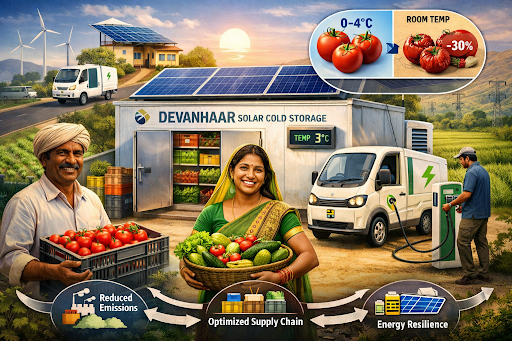
Primary causes include inadequate cold chain infrastructure, power outages during transport, and lack of on-farm storage. Tomatoes, for instance, spoil within 3-5 days at ambient temperatures but can last 21 days when stored at 0-4 degrees Celsius.
How Solar Cold Storage Works
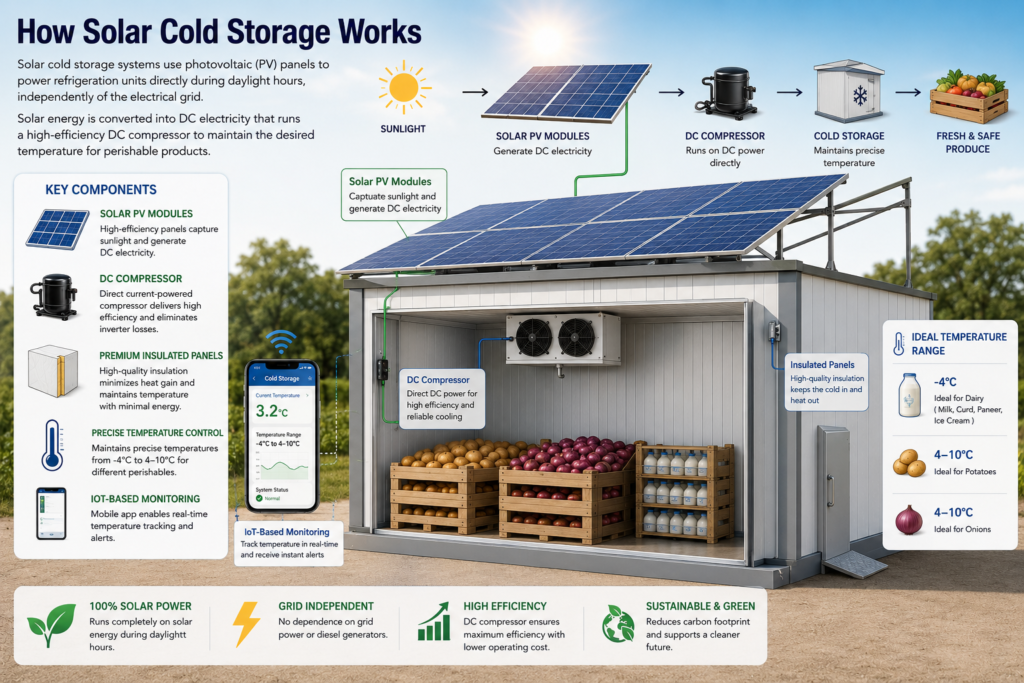
Solar cold storage systems harness photovoltaic panels to power refrigeration units independently of the electrical grid. Unlike traditional cold storage that relies on diesel generators or unstable grid power, solar units generate their own electricity during daylight hours and store excess energy for nighttime or cloudy conditions.
Core components include high-efficiency solar PV modules capturing sunlight, direct current-powered compressors that eliminate inverter losses, lithium-ion batteries providing 7-10 days of autonomy, premium insulated panels maintaining temperatures with minimal energy, and IoT-based mobile apps enabling real-time temperature tracking. These systems maintain precise temperatures ranging from -4 degrees Celsius for dairy to 4-10 degrees Celsius, ideal for potatoes and onions.
Environmental Impact: Cutting Carbon Emissions
Traditional cold storage contributes significantly to India’s carbon footprint. A typical 100-tonne facility running on diesel generators emits 180-220 tonnes of CO₂ annually, while grid-connected units in coal-dependent regions produce 150-180 tonnes per year.
Solar cold storage eliminates these emissions through renewable energy. Annual CO₂ emissions drop from 180-220 tonnes to just 20-30 tonnes, representing an 85-90% reduction. Energy sources shift completely from diesel and coal-based grid power to solar PV, achieving 100% clean operation. Natural refrigerants like R290 replace high-GWP HFCs, lowering environmental impact by 95%. Operational energy costs fall from ₹5-10 per kWh to zero after the initial payback period.
Over a 20-year lifespan, a single 20-tonne solar unit offsets 3,000+ tonnes of CO₂, equivalent to planting 150,000 trees.
Economic Benefits for Farmers
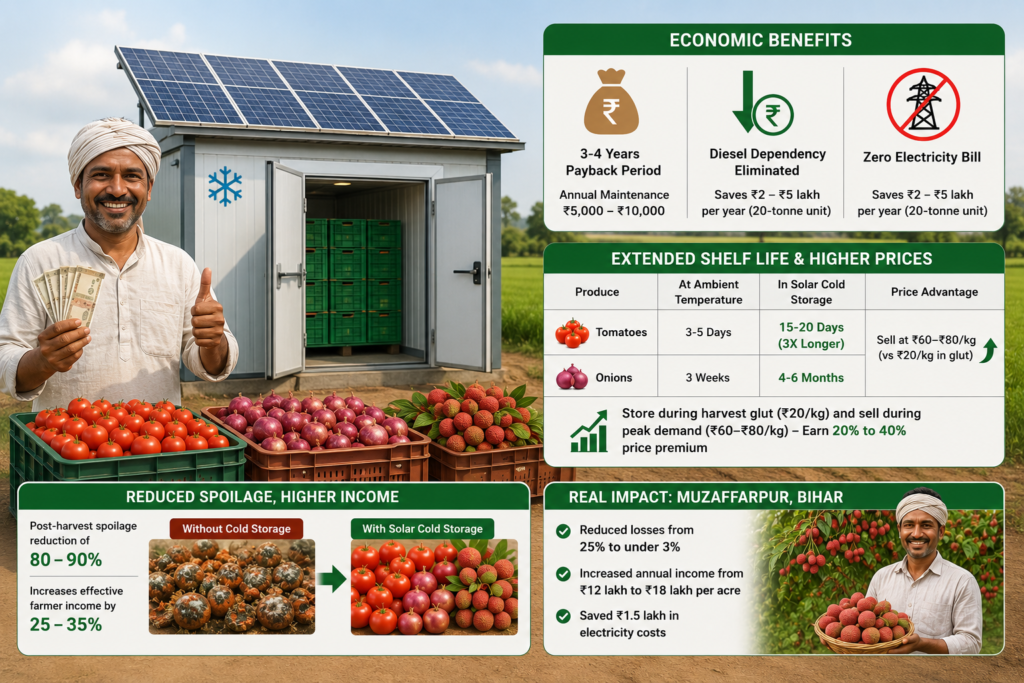
The economic advantages of solar cold storage extend beyond waste reduction. After the initial investment with a typical 3-4 year payback, operational costs drop to ₹5,000-10,000 annually for maintenance, eliminating electricity bills entirely. Diesel dependency disappears, removing ₹5-10 per kWh fuel costs and saving ₹2-5 lakh yearly for 20-tonne units.
Extended shelf life transforms profitability. Tomatoes last 3 times longer, while onions remain fresh for 4-6 months compared to 3 weeks at ambient temperatures. Farmers gain market timing flexibility, storing produce during harvest glut when prices drop to ₹20 per kilogram and selling during peak demand at ₹60-80 per kilogram, capturing 20-40% price premiums.
Post-harvest spoilage reductions of 80-90% increase effective farmer income by 25-35%. A 15-tonne solar unit in Bihar’s Muzaffarpur district helped lychee farmers reduce losses from 25% to under 3%, increasing annual income from ₹12 lakh to ₹18 lakh per acre while saving ₹1.5 lakh in electricity costs.
Real-World Applications Across India
Solar cold storage proves effective in diverse agricultural contexts. Micro-units of 5-10 tonnes deployed directly on farms enable immediate post-harvest pre-cooling. In Maharashtra’s Nashik region, grape farmers using 5-tonne units extended shelf life from 7 to 21 days, accessing Mumbai markets 400 kilometers away without spoilage.
Farmer cooperatives in Punjab operate 30-tonne solar facilities serving 200+ potato growers. The collective model reduces individual costs while enabling bulk storage and coordinated market release, increasing average farmer income by 30%.
In Rajasthan’s arid belts, where grid outages exceed 15 hours daily, solar units provide uninterrupted cooling. A 10-tonne installation preserved 15 tonnes of onions through a 12-day blackout, enabling farmers to sell at 20% above market rates.
Technology and Challenges
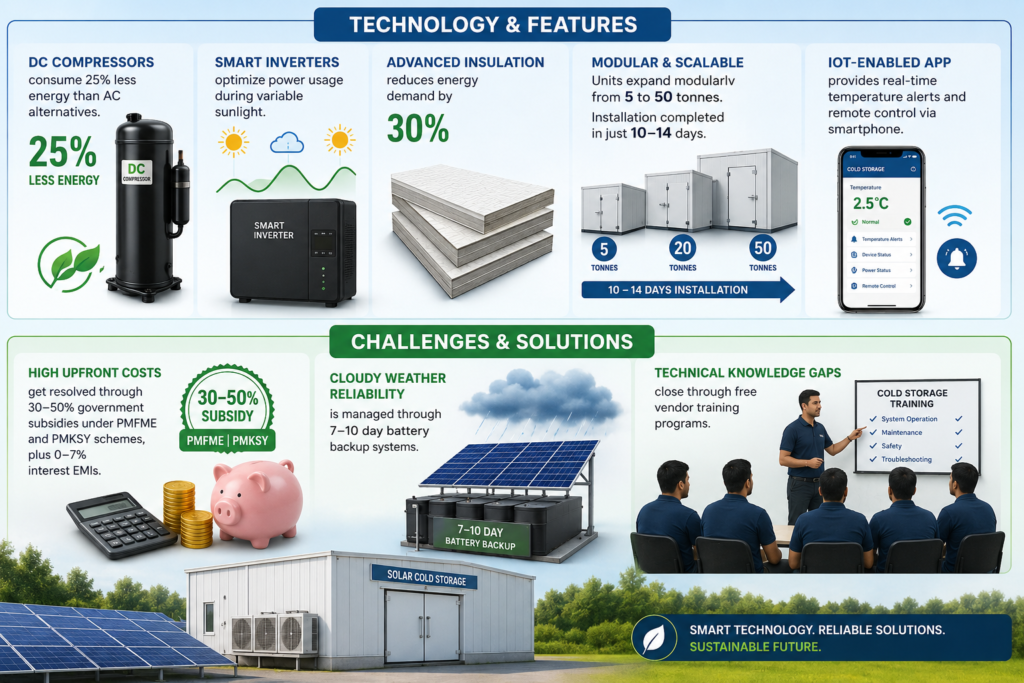
DC compressors consume 25% less energy than AC alternatives, while smart inverters optimize power usage during variable sunlight. Advanced insulation reduces energy demand by 30%. Units expand modularly from 5 to 50 tonnes, with installation completed in just 10-14 days. IoT-enabled apps provide real-time temperature alerts and remote control via smartphone.
High upfront costs get resolved through 30-50% government subsidies under PMFME and PMKSY schemes, plus 0-7% interest EMIs. Cloudy weather reliability is managed through 7-10 day battery backup systems. Technical knowledge gaps close through free vendor training programs.
Policy Support and Future Outlook
Government initiatives are accelerating deployment. The PM-KUSUM scheme offers up to a 30% capital subsidy for solar agricultural infrastructure. State-level incentives in Andhra Pradesh, Gujarat, and Rajasthan provide 35% capital subsidies plus SGST reimbursement.
Experts project 20,000+ units nationwide by 2030, potentially halving post-harvest losses and contributing ₹1 lakh crore annually to GDP.
The Path Forward
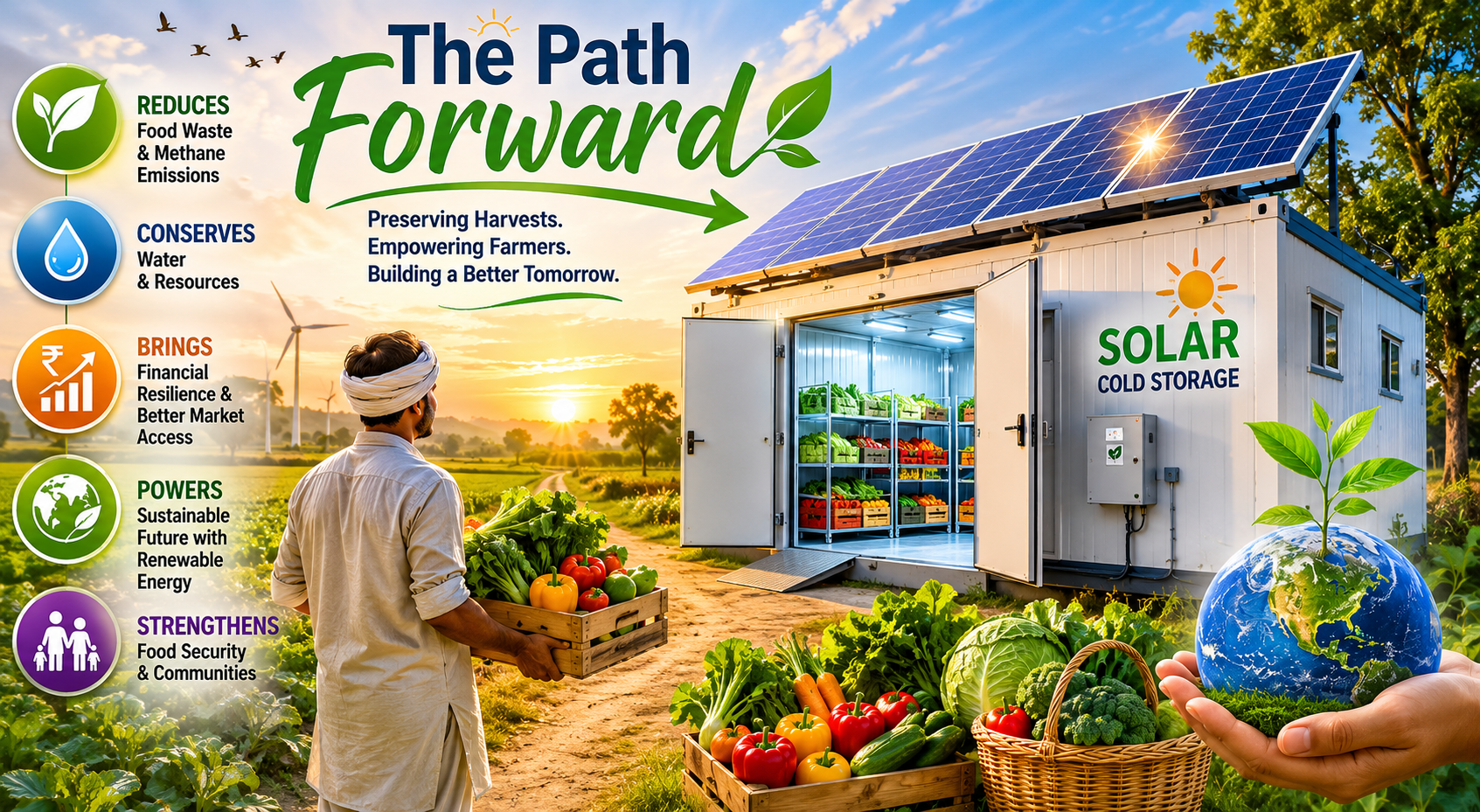
Solar cold storage represents a pathway to food security, rural prosperity, and climate action. By preserving produce that would otherwise decompose, these systems reduce methane emissions from landfills and conserve water and labor invested in growing crops.
For farmers, the transition brings financial resilience through reduced losses and better market access. Renewable energy contributes to significant carbon reduction for the environment, while society benefits from less waste and greater food security.
Investing in solar cold storage today builds a sustainable food system for tomorrow, one where harvests are preserved, farmers thrive, and the planet benefits.