
Ausa is an important agricultural location in Latur district of Maharashtra, where farming and agro-based activities play an important role in the local economy. For entrepreneurs looking to convert sugarcane into a value-added product, jaggery manufacturing can be a practical business opportunity when supported by proper raw-material planning and suitable processing technology. A modern Automatic Jaggery Plant in Ausa, Maharashtra is designed to bring better organization and control to the traditional jaggery-making process. Instead of depending heavily on manual operations, an automatic plant combines different processing stages into a connected production system. This can make day-to-day operations easier to manage while supporting better consistency in the final product.

The first requirement for any sugarcane-based processing business is a dependable source of raw material. For a Jaggery Plant in Ausa, entrepreneurs should study sugarcane availability in Ausa and nearby areas before deciding the plant capacity. A local procurement network can make a major difference to plant operations. When sugarcane is sourced from nearby farming areas, transportation can be planned more efficiently, and the manufacturer can develop direct relationships with farmers and local suppliers. At the same time, location alone does not determine the success of a jaggery plant. Seasonal sugarcane availability, procurement cost, transportation, land, water, electricity, labour, and the market for finished jaggery should all be considered before starting the project.
An Automatic Jaggery Plant is a modern sugarcane-processing system that uses machinery to handle important stages of jaggery production with less manual intervention. The plant can include systems for sugarcane crushing, juice filtration, clarification, concentration, heating, cooking, cooling, and jaggery formation. The exact equipment and level of automation depend on the required capacity and type of product. The main advantage of automation is better process control. In traditional production, several operations may depend on manual judgement and handling. A properly designed automated system can make these operations more systematic and consistent. The objective is not simply to produce more jaggery. It is to create a production process that is easier to operate, monitor, maintain, and scale according to business requirements.
The process starts with sugarcane feeding and crushing. Sugarcane passes through the crushing system, where juice is extracted from the cane. The remaining fibrous material is known as bagasse. The extracted juice contains natural impurities and therefore requires suitable filtration and clarification before concentration. Clean juice is then sent to the heating and concentration section. During concentration, water is removed through controlled heating and evaporation.

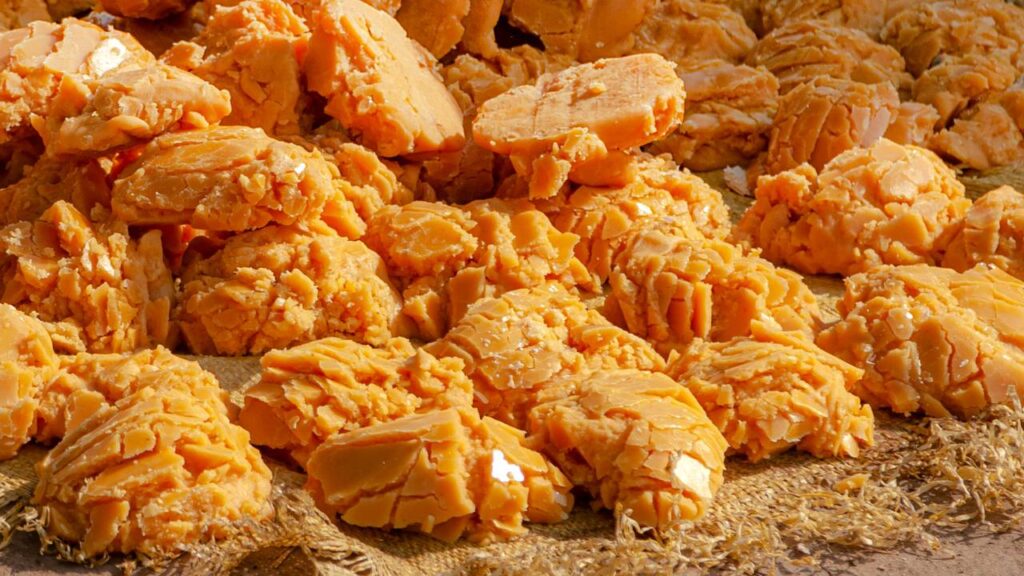
This stage needs proper process management because the final consistency of jaggery depends greatly on how the juice is concentrated and cooked. After reaching the desired consistency, the material is cooled and transferred for forming or further processing. Depending on the plant configuration, the finished product can be made into jaggery blocks, solid jaggery, or jaggery powder. This connected process allows the different stages of production to work together instead of treating each operation as a separate activity.
One of the useful by-products generated during sugarcane crushing is bagasse. It is the fibrous material left after extracting juice from sugarcane. In a suitably designed jaggery plant, bagasse can be used as a biomass fuel for process heating. This gives the manufacturer an opportunity to make productive use of a material already generated within the plant. Efficient bagasse utilization can reduce dependence on externally purchased fuels and improve overall resource utilization. It can also support a more sustainable approach to jaggery production. The actual fuel requirement and performance depend on factors such as bagasse moisture, quantity available, heating requirements, and the design of the boiler or furnace system. Therefore, the fuel arrangement should be considered during the initial plant design.
Today, jaggery is sold through more than traditional local markets. It is also used by food manufacturers, sweet producers, retailers, packaged-food businesses, and other commercial buyers. This makes jaggery quality and hygiene increasingly important for manufacturers who want to build a reliable market. A modern plant can provide better control over juice processing, filtration, heating, and product handling. Suitable food-contact equipment and proper cleaning practices can help maintain a cleaner production environment. However, machinery alone cannot guarantee quality. Good-quality sugarcane, proper filtration, controlled processing, equipment maintenance, hygienic handling, and appropriate storage are all important for producing a consistent product.

Traditional jaggery blocks remain an important product, but jaggery powder provides manufacturers with another opportunity for value addition. Powdered jaggery is convenient to measure, use, pack, and transport. It can be used in beverages, sweets, bakery products, traditional foods, confectionery, and several food-processing applications. For a manufacturer in Ausa, producing jaggery powder can also help target customers who prefer convenient packaged products. Whether a plant should manufacture solid jaggery, blocks, powder, or multiple product formats depends on the target market, investment, processing requirements, packaging facilities, and expected demand.
Selecting the correct jaggery plant capacity is one of the most important decisions before starting the project. Capacity should be based on the quantity of sugarcane that can realistically be procured during the operating season. Installing a larger plant without sufficient raw-material availability can create unnecessary operating and financial pressure.
Before finalizing the capacity, an entrepreneur should evaluate:
A practical plant capacity should match the available resources and the actual business plan rather than being selected only because of a higher production number.

Jaggery manufacturing provides an opportunity to add value to sugarcane. Instead of selling sugarcane only as an agricultural commodity, an entrepreneur can process it into a finished food product and generate additional value through production, packaging, branding, and distribution. However, the business should be planned using realistic financial calculations. Sugarcane purchase price, jaggery recovery, labour, fuel, electricity, packaging, transportation, maintenance, and selling price all influence the final economics. Market planning is equally important. A manufacturer should identify potential buyers and decide whether the business will focus on local markets, wholesalers, retailers, food manufacturers, institutional buyers, or packaged consumer products.
Devanhaar Technologies provides modern Jaggery Plant Solutions with a focus on automation, process efficiency, fuel utilization, and practical plant design. For entrepreneurs planning an Automatic Jaggery Plant in Ausa, Maharashtra, the plant can be designed according to the required production capacity, sugarcane availability, product type, site conditions, and business objectives. A successful plant requires different sections to work together. Sugarcane crushing, juice filtration, concentration, heating, fuel management, cooling, forming, and packaging should be considered as parts of one integrated manufacturing system. Devanhaar Technologies focuses on developing plant solutions around the specific requirements of the project rather than using the same approach for every business.

An Automatic Jaggery Plant in Ausa, Maharashtra can provide an opportunity to convert sugarcane into a value-added food product using modern processing technology. Automation can help organize production, reduce unnecessary manual handling, improve process control, and support consistent manufacturing. For anyone planning a Jaggery Plant in Ausa, the project should begin with a practical assessment of sugarcane availability, plant capacity, investment, utilities, product demand, and operating costs. With suitable technology, efficient bagasse utilization, proper quality management, and a clear market strategy, a jaggery manufacturing unit can be developed into a structured and scalable business. Devanhaar Technologies provides customized Automatic Jaggery Plant solutions in Ausa, Maharashtra, helping entrepreneurs plan their sugarcane-processing business according to their specific production and business requirements.