

Devanhaar Technologies specializes in automatic jaggery and sugar processing solutions, offering fully automated jaggery plants, jaggery powder plants, and advanced sugarcane processing machinery. Our innovations focus on fuel and water savings, faster production, and eco-friendly operations, ensuring pure, high-quality jaggery with minimal labor and maximum efficiency. 🌿⚙️
Aurangabad (Chhatrapati Sambhajinagar) is an important agricultural and industrial centre in Maharashtra’s Marathwada region. The area has a strong agricultural economy and an established sugarcane-processing ecosystem, creating opportunities for businesses interested in converting sugarcane into value-added products such as jaggery and jaggery powder. An Automatic Jaggery Plant in Aurangabad (Chhatrapati Sambhajinagar) can help manufacturers move from traditional jaggery production toward a more organized, efficient, and controlled manufacturing process. Modern technology can improve process consistency, hygiene, fuel utilization, and overall plant management.
Sugarcane availability is one of the most important factors when planning a jaggery manufacturing unit. Aurangabad and the surrounding Marathwada region have an established agricultural and sugar-processing base, making the area worth considering for a sugarcane-based processing business. A plant located closer to sugarcane-producing areas can make raw-material procurement and transportation easier. Freshly harvested sugarcane can also be brought to the processing facility within a suitable time, helping manufacturers manage the quality of the extracted juice. However, plant capacity should always be selected according to the actual availability of sugarcane. Before investment, entrepreneurs should evaluate local procurement possibilities, seasonal supply, transportation, farmer networks, and expected production requirements.
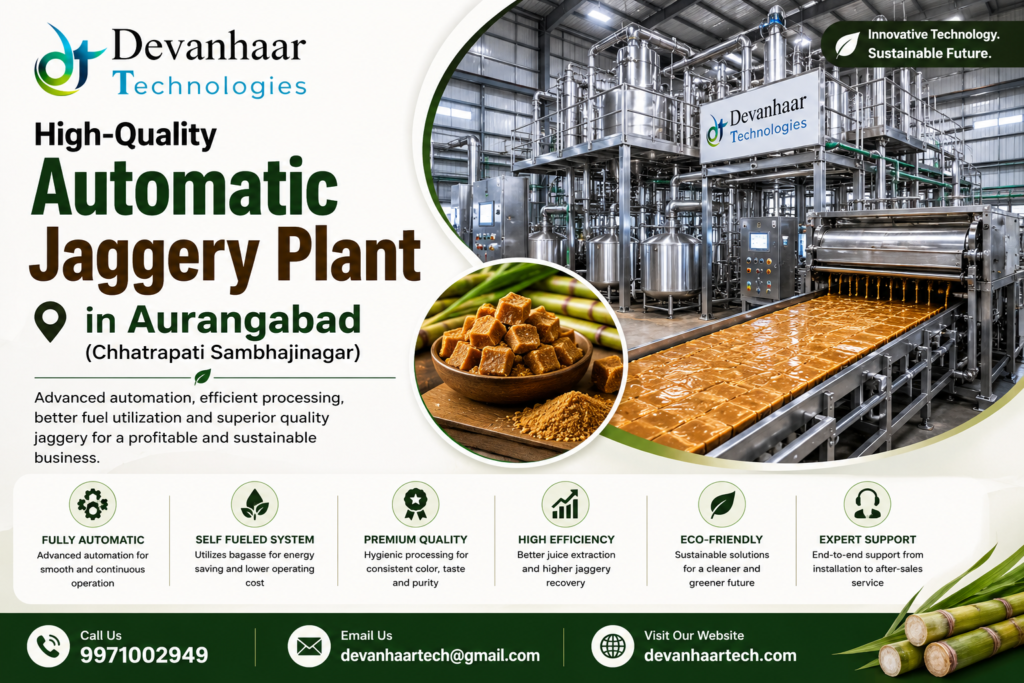
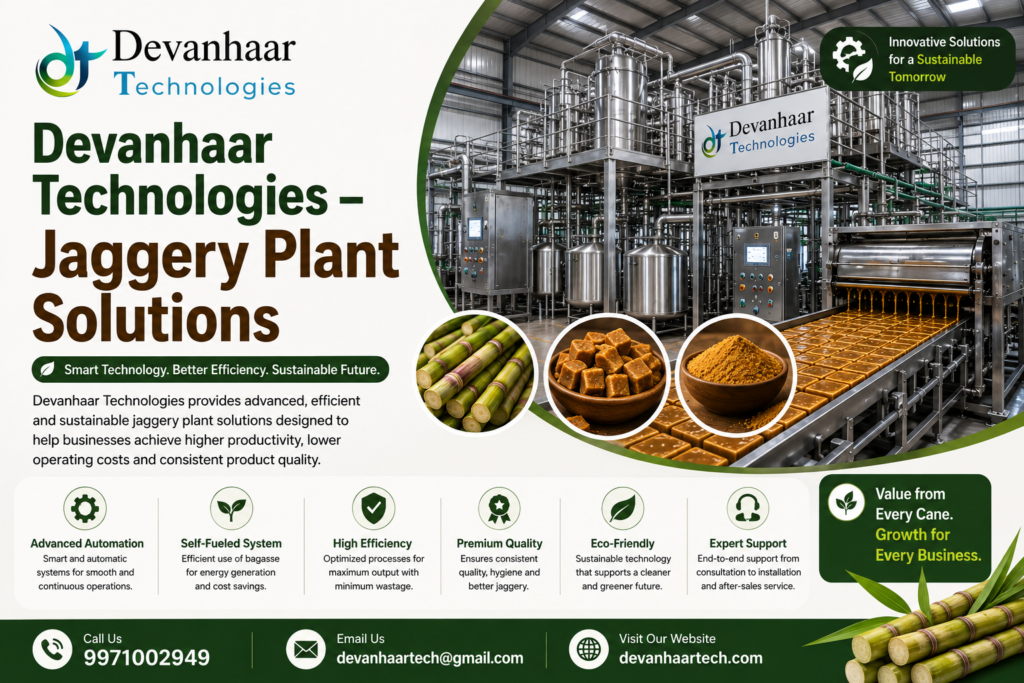
An automatic jaggery plant is a modern processing system designed to reduce manual work during different stages of jaggery manufacturing. Instead of depending completely on traditional open-pan methods, the plant uses machinery and controlled processes for sugarcane crushing, juice handling, filtration, concentration, heating, cooking, cooling, and jaggery formation. The purpose of automation is not only to increase production. It also helps provide better control over the manufacturing process and can improve consistency between production batches. Depending on the business requirement, the plant can be designed to manufacture solid jaggery, jaggery blocks, jaggery powder, and other customized jaggery products.
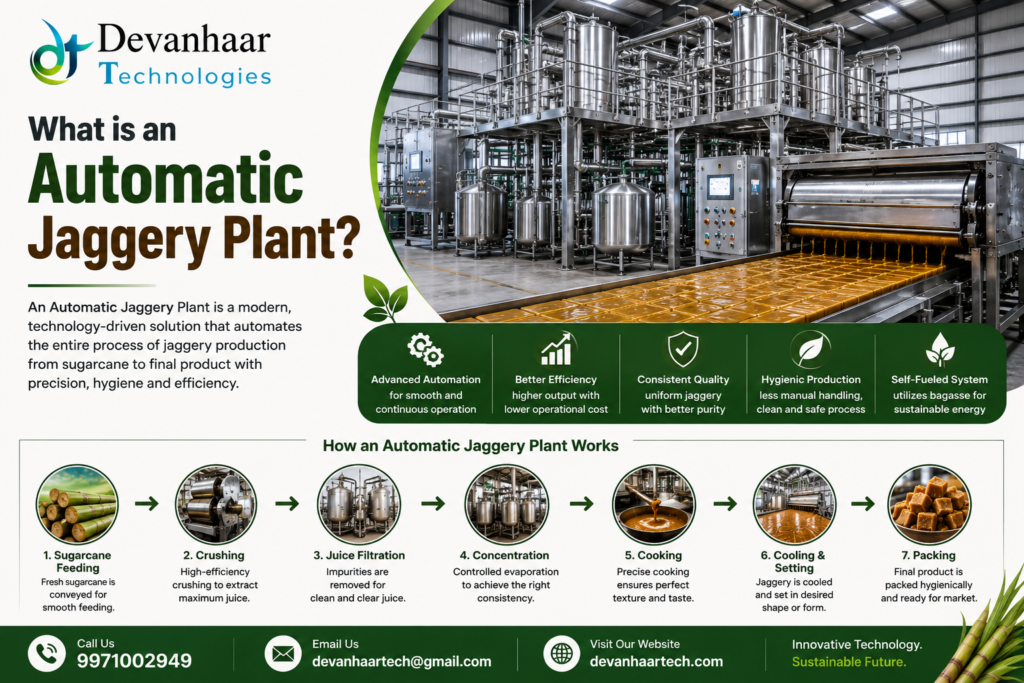
The process begins with feeding sugarcane into the crushing system. The crusher extracts juice from the cane while separating the fibrous residue known as bagasse. The extracted juice is then filtered and clarified to remove unwanted impurities. After filtration, the juice is concentrated through controlled heating and evaporation. This stage is important because the concentration of the juice directly affects the final characteristics of the jaggery. Once the required consistency is achieved, the concentrated jaggery is cooled and processed into the desired form. Depending on the plant configuration, it can be converted into blocks, solid jaggery, or powder. A controlled manufacturing system can help reduce variations in the process and provide better consistency in the finished product.
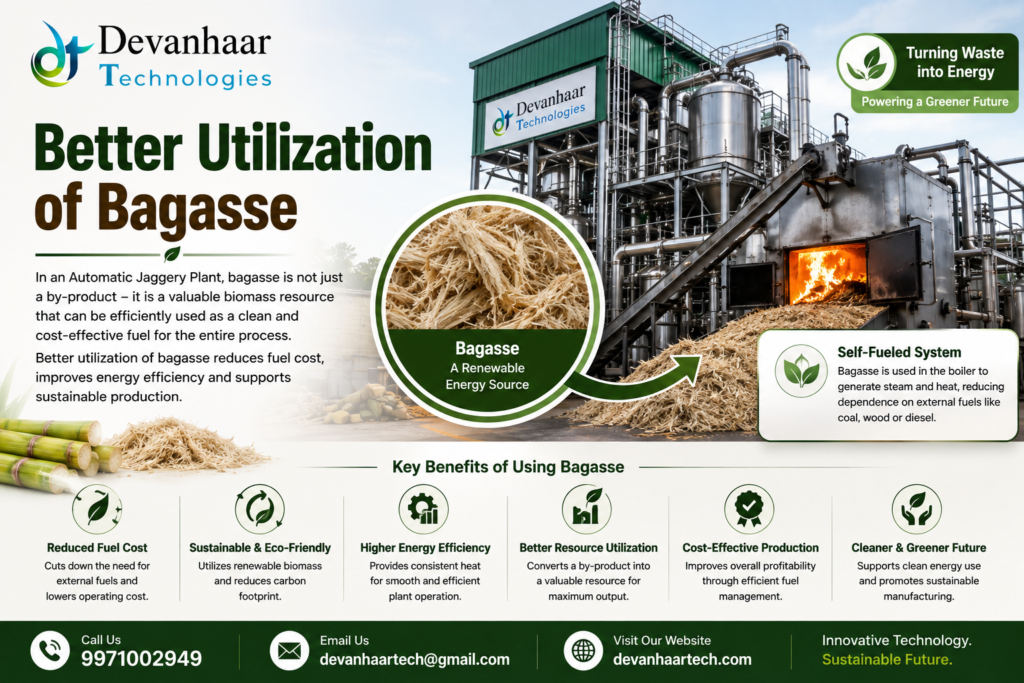
Bagasse is an important by-product of sugarcane crushing. Instead of treating it only as waste, a suitably designed jaggery plant can utilize bagasse as a biomass fuel. Using bagasse for process heating can reduce dependence on externally purchased fuels and improve the utilization of sugarcane by-products. It can also contribute to a more sustainable production system. The actual fuel system depends on the plant design, energy requirement, moisture content of bagasse, and overall plant configuration. Therefore, fuel utilization should be considered during the initial plant design rather than added later.
Jaggery is increasingly being sold through organized retail, packaged-food businesses, sweet manufacturers, food processors, and other commercial channels. As the market becomes more organized, product quality and hygiene become increasingly important. A modern jaggery plant can provide a more controlled production environment than traditional open processing. Proper filtration, suitable food-contact equipment, controlled heating, regular cleaning, and good manufacturing practices can help maintain product quality. Automation can also reduce unnecessary manual handling during different stages of production. However, hygiene still depends on proper plant maintenance, cleaning procedures, raw-material quality, and trained workers.
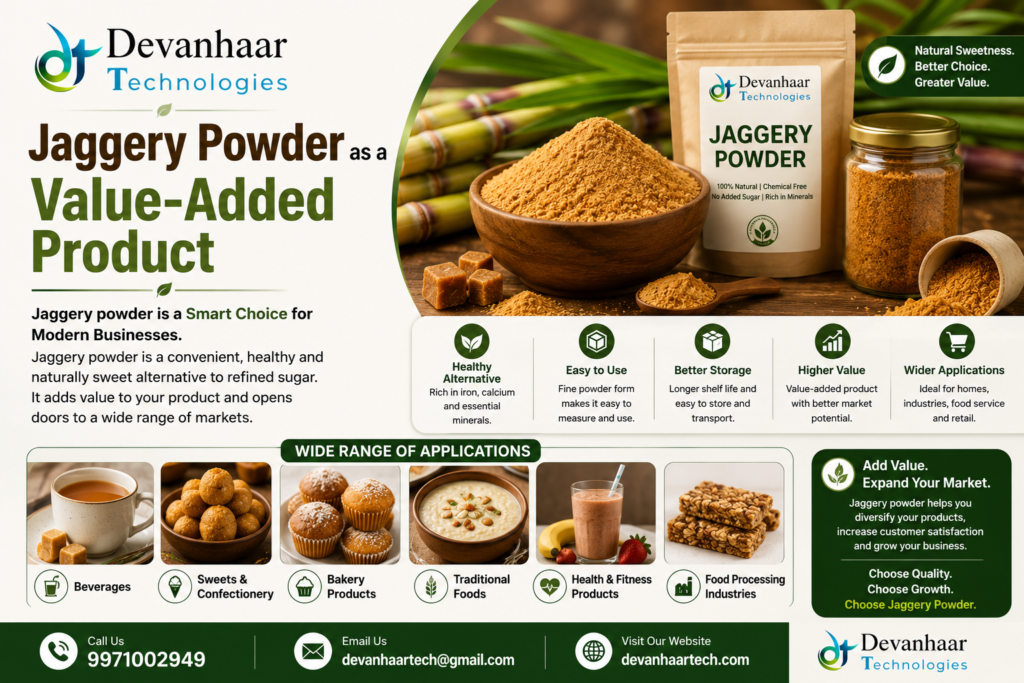
Jaggery powder offers manufacturers an opportunity to expand beyond traditional jaggery blocks. Its convenient form makes it easier to measure, store, pack, transport, and use. It can be used in beverages, sweets, bakery products, confectionery, traditional foods, and various food-processing applications. This makes jaggery powder suitable for both retail and industrial markets. For an entrepreneur in Aurangabad, the decision to manufacture solid jaggery, jaggery powder, or both should depend on market demand, investment capacity, production requirements, packaging facilities, and target customers.
Choosing the right capacity is an important part of establishing a jaggery plant. The capacity should be based on the amount of sugarcane that can realistically be procured during the operating season. Entrepreneurs should consider sugarcane availability, procurement distance, land, electricity, water, labour, fuel requirements, storage, and market demand before finalizing the plant. A higher-capacity plant is not always a better investment. If raw material is not available consistently or the finished product does not have a reliable market, excess capacity can increase operating costs and business risk. The plant should therefore be designed around the actual business model and available resources.
Jaggery manufacturing provides an opportunity to add value to agricultural produce. Instead of selling only raw sugarcane, entrepreneurs can process it into a finished food product and create additional value through manufacturing, packaging, branding, and distribution. However, profitability should be calculated using realistic operating costs. Important factors include sugarcane purchase price, jaggery recovery, labour, electricity, fuel, packaging, transportation, maintenance, and market selling price. A successful jaggery business requires more than production capacity. Consistent quality, efficient operations, reliable raw-material sourcing, and a strong sales strategy are equally important.
Devanhaar Technologies provides modern jaggery plant solutions focused on automation, process efficiency, fuel utilization, and practical industrial design. For entrepreneurs planning a Jaggery Plant in Aurangabad (Chhatrapati Sambhajinagar), the plant can be planned according to production capacity, sugarcane availability, product requirements, site conditions, and business objectives. A well-designed jaggery plant works as an integrated system. Sugarcane handling, crushing, juice filtration, concentration, heating, fuel management, cooling, forming, and packaging need to work together for efficient production. For businesses in Aurangabad and nearby sugarcane-producing areas, modern jaggery processing can provide an opportunity to develop a structured value-added agricultural business.
An Advance Automatic Jaggery Plant in Aurangabad (Chhatrapati Sambhajinagar) can help entrepreneurs convert locally available sugarcane into value-added jaggery products through modern and controlled processing. With the right plant capacity, efficient fuel utilization, proper hygiene, consistent quality, and realistic business planning, jaggery manufacturing can become a scalable processing business. Devanhaar Technologies offers customized jaggery plant solutions designed around specific production requirements and business goals. For entrepreneurs planning a jaggery plant in Aurangabad (Chhatrapati Sambhajinagar), Maharashtra, proper planning and suitable technology can provide a strong foundation for efficient and sustainable jaggery manufacturing.


